Geopolitics fuels LNG risk, with LNG strategy in a system defined by disruption
While resolution now appears more imminent, months of war between the US/Israel and Iran have brought new perils to the LNG business and heightened existing risks. The war is the latest in a succession of geopolitical disruptions that have permanently reshaped LNG, among them conflict, sanctions, and trade restrictions.
Decision making based solely on economic considerations no longer ‘cuts it’; CEOs and their C-Suite colleagues now face the challenge of integrating geopolitics into strategy, building resilience, prioritising optionality, strengthening logistics, and accelerating decision making processes to align them with the pace of market change.
There is no going back.
How are industry players reacting?
It is not possible to know what is going on inside the minds of business leaders unless organisations exhibit outward signs of changing strategies. So far, the response appears to have been a wait-and-see approach. One market commentator recently described the current situation as “an eerie calm”.
During periods of market stress and unprecedented circumstances, the scope for unconventional behaviour and the resulting contractual disputes between sellers and buyers, will be substantial. And as the LNG business evolves, new causes for disputes are likely to manifest – and a key role will be played in strengthening resolution.
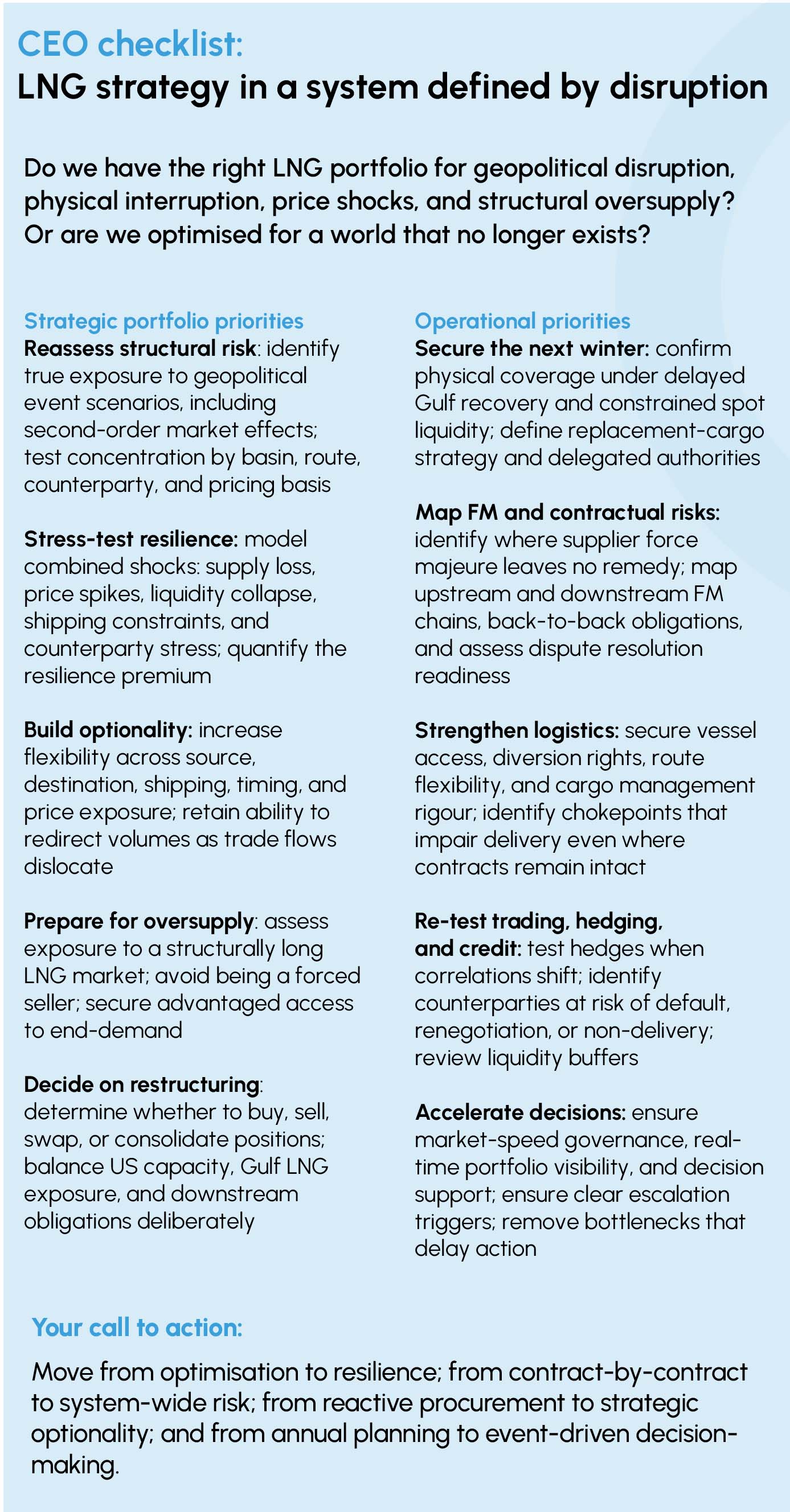
CEO check list
Do CEO’s have the right LNG portfolio for geopolitical disruption, physical interruption, price shocks, and structural oversupply? Or are they optimised for a world that no longer exists?
The call to action to CEO’s and their C-Suite is to avoid indecision and inaction; move from optimisation to resilience, from contract-by-contract to system-wide risk; from reactive procurement to strategic optionality; and from annual planning to event-driven decision making.
Source: Gas Strategies, June 2026
Read the Gas Strategies Mid-Year LNG Focus 2026 and accelerate your ability to compete in a changed world.