Gas Strategies is currently working with clients in several markets where waning production and robust demand are requiring them to address the future structure of their gas industry, including finding an optimal balance between existing indigenous gas, possible exploration, and LNG imports. We see many markets facing similar energy security challenges in the near-term.
Highlights
For markets with declining gas, the next five years offers an opportunity to access more competitive LNG imports – thereby rebalancing energy systems and setting economies on a sustainable path.
228 Mtpa of new liquefaction capacity will come into the market between now and 2030, representing 47% increase in liquefaction capacity. In Gas Strategies’ view, global LNG demand will lag behind this ‘glut’ in the short-term, resulting in ‘spare’ LNG volumes typically held by portfolio players, greater spot market activity, and an accompanying fall in prices.
The role of LNG in markets with declining gas is to provide greater security and flexibility of gas supply, a supply which is vital to power generation, industry feedstock and grid resilience as the energy transition continues. Without rebalancing their energy systems, these markets risk poor energy security and serious economic loss.
When the global market last saw a ‘supply glut’ in the latter half of the2010s, the market witnessed 11 new LNG-importing countries, as well as expansion of LNG imports within existing, but price-sensitive LNG markets.
Although a market opportunity is emerging, import markets will need to confront the economic and infrastructure implications of a destabilised value chain, while handling the complexity of integrating LNG.
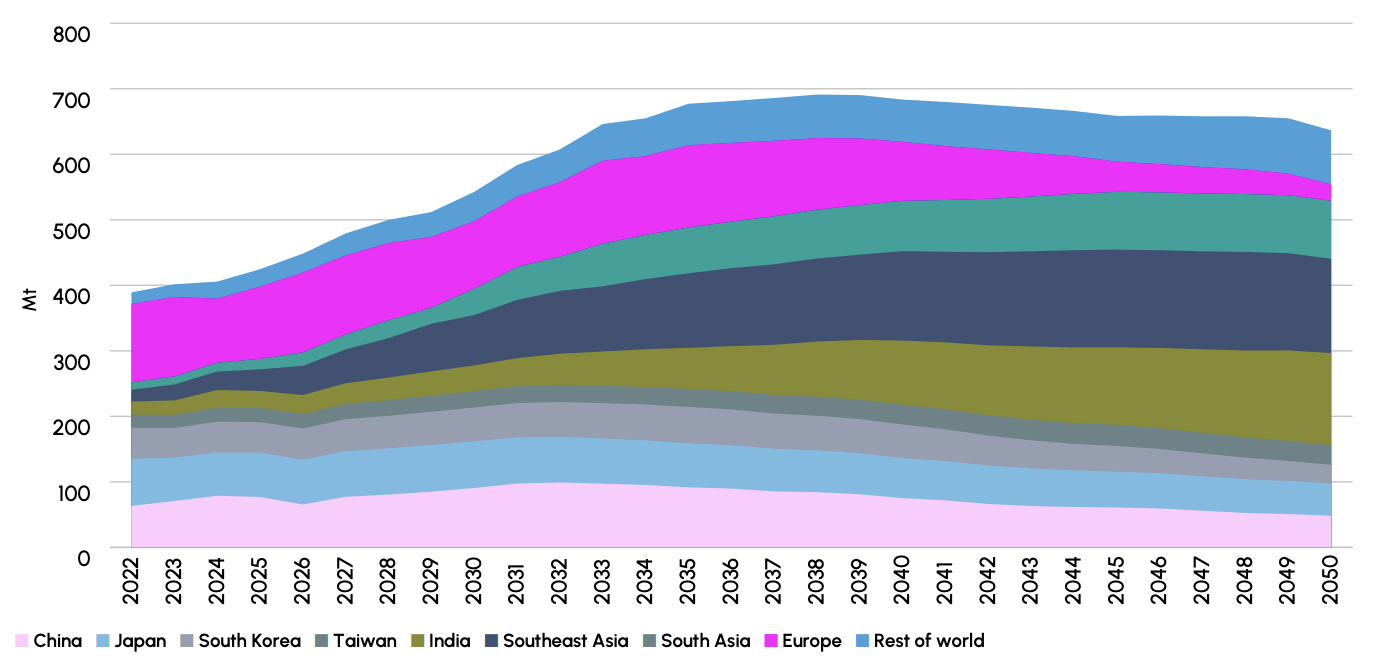
Gas Strategies’ LNG Demand Forecast by Market (September 2025)
Source: Gas Strategies
Learn more about our Perspective and download now.
Contact us to discuss the challenges of rebalancing your energy industry.