Public data suggests FLNG projects are increasingly cost competitive with greenfield onshore liquefaction and even brownfield onshore liquefaction expansion.
Given this reality, debate should focus on how FLNG will evolve over time and whether FLNG capacity will remain relatively modest compared to onshore plants.
This Perspective explores four nascent trends in FLNG, their drivers and potential consequences.
Highlights
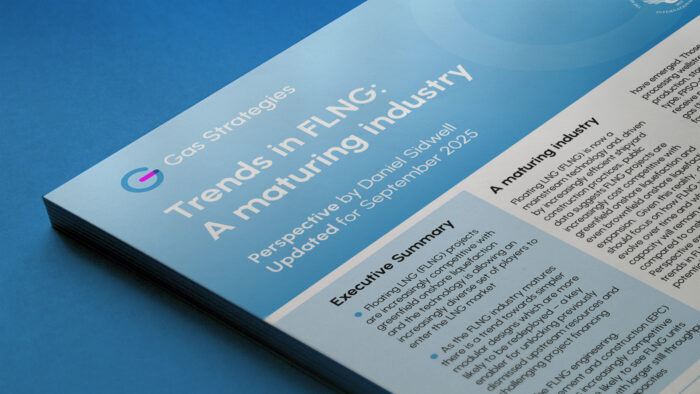
- Floating LNG (FLNG) projects are increasingly competitive with greenfield onshore liquefaction and the technology is allowing an increasingly diverse set of players to enter the LNG market
- An increasing number of liquefaction projects are utilising floating LNG storage. Separate floating LNG storage can simplify engineering designs and allows the repurposing of existing infrastructure, in turn reducing capex and construction timelines
- As the FLNG industry matures there is a trend towards simpler modular designs which are more likely to be redeployed – a key enabler for unlocking previously dismissed upstream resources and challenging project financing
- The FLNG engineering, procurement and construction (EPC) market is increasingly competitive and we are likely to see FLNG units sanctioned with larger still throughput and storage capacities
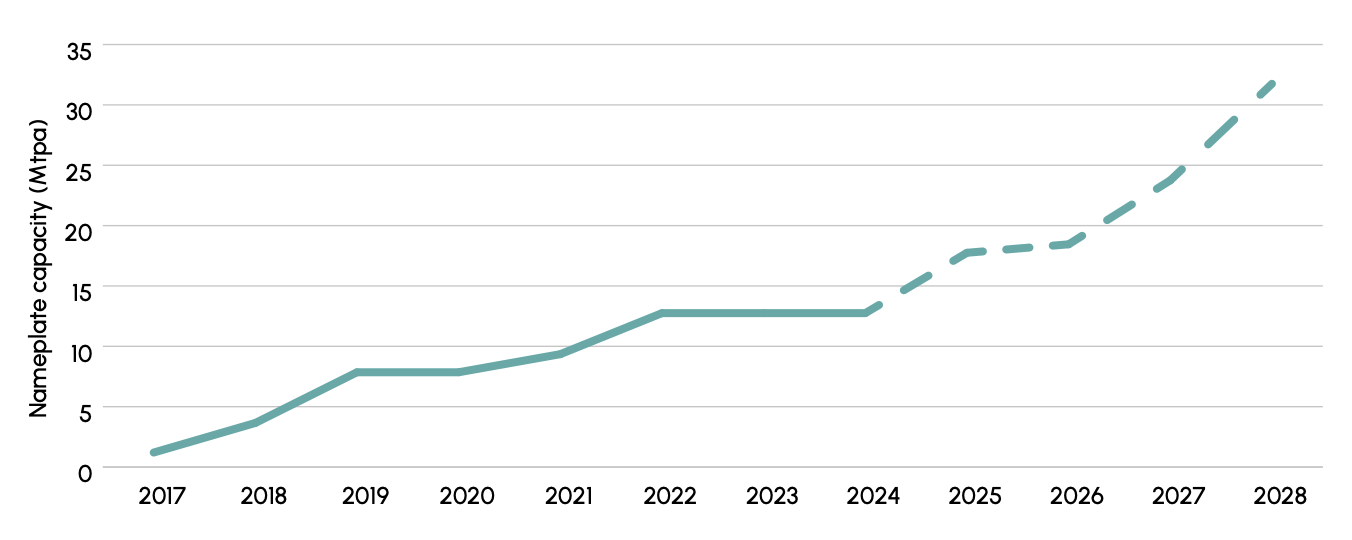
Cumulative global FLNG capacity (excluding redeployments, September 2025)
Source: Gas Strategies
- FLNG is now a mainstream technology, with supported by more efficient shipyard construction and cost levels that now rival both new onshore plants and expansions of existing facilities
FLNG plays an increasingly important role across the LNG industry. To explore the trends shaping this shift, download our Perspective.